

Construction Site Safety: 15 Essential Rules Every Worker Should Know
Introduction: Construction Safety Starts Before the Work Begins
Construction sites change every day. Yesterday’s clear access route may become today’s excavation zone. New scaffolding may appear overnight. Cranes, trucks, temporary electrical systems, welding operations, power tools, contractors, and workers can all operate within the same limited space.
This constantly changing environment makes construction site safety one of the most demanding areas of occupational safety.
In 2026, construction safety is also moving beyond basic compliance. Heat exposure, fatigue, multilingual workforces, digital reporting, online training, AI-powered hazard detection, wearable technology, and real-time monitoring are becoming increasingly important alongside traditional controls such as PPE, fall protection, scaffolding inspections, and safe lifting.
At Unbox Safety LMS, we focus on making construction safety training visual, standardized, accessible, and easier for workers to understand through digital courses, safety videos, interactive animation, and 3D safety training.
Here are 15 essential construction site safety rules every worker should know and follow.
1. Complete Site Safety Induction Before Starting Work
No worker, contractor, or visitor should enter an active construction area without understanding its major hazards.
Site induction should explain emergency exits, assembly points, restricted zones, traffic routes, PPE requirements, permit systems, reporting procedures, and current high-risk activities.
Training must also be understandable to the workforce. Multilingual safety videos and visual instructions can help communicate the same procedure consistently across different languages and literacy levels.
2. Wear the Correct PPE
Personal protective equipment is one of the most visible elements of construction worker safety.
Depending on the activity, workers may require:
- Safety helmet
- Safety footwear
- High-visibility clothing
- Safety goggles or face shield
- Gloves
- Hearing protection
- Respiratory protection
- Full-body safety harness
PPE must be appropriate for the specific hazard, properly fitted, maintained, and inspected before use.
Wearing a helmet alone does not make a worker safe. PPE must form part of a wider hazard-control system.
3. Never Compromise on Work-at-Height Safety
Falls remain one of construction’s most serious hazards.
Employees working near open edges, roofs, elevated platforms, floor openings, scaffolds, or other fall exposures must use appropriate protection.
This may include guardrails, safety nets, approved anchorage systems, full-body harnesses, lifelines, or other compliant fall-protection systems.
Workers must also be trained to inspect their equipment before use.
Never improvise an anchorage point or disconnect fall protection merely to reach a difficult location.
4. Inspect Scaffolding Before Use
Scaffolding should never be treated as temporary equipment that requires temporary safety standards.
Before using a scaffold, verify that it is properly erected, stable, adequately supported, correctly accessed, and suitable for the intended load.
Platforms should be properly secured, guardrails installed where required, and unsafe gaps or damaged components corrected.
Scaffolds should also be protected from unauthorized modification.
Only competent and authorized personnel should make structural changes.
5. Use Ladders Correctly
A ladder is an access tool, not an improvised working platform.
Inspect ladders before use for damaged rungs, bent rails, loose components, contamination, or other defects.
Place the ladder on a firm and stable surface and maintain secure contact while climbing.
Never stand on an unsuitable upper rung, overreach sideways, or use a metal ladder where electrical exposure creates additional risk.
Whenever possible, select safer access equipment for longer-duration tasks.
6. Maintain Safe Distance from Moving Equipment
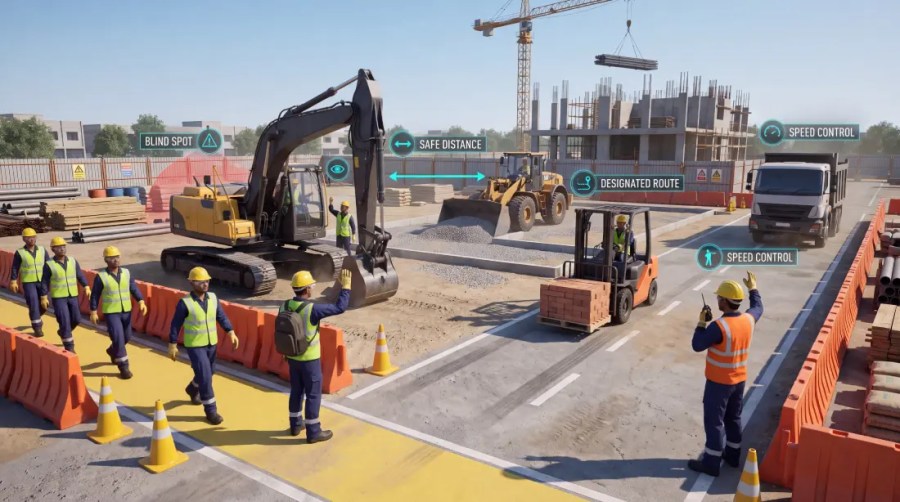
Construction sites frequently involve excavators, loaders, cranes, forklifts, dump trucks, concrete vehicles, and other mobile plant.
Pedestrians must stay within designated routes and remain outside equipment blind spots.
Operators should use approved routes, warning devices, spotters where required, and site-specific speed controls.
Workers should never assume an operator has seen them.
Establish visual communication before entering an equipment operating zone.
7. Follow Safe Lifting and Rigging Procedures
Suspended loads can cause catastrophic injuries.
Never stand, walk, or work beneath a suspended load.
Before lifting, inspect slings, hooks, shackles, chains, wire ropes, and lifting accessories. Confirm that the load is within the rated capacity of the equipment.
Rigging should be performed only by trained and authorized personnel.
Workers must also respect barricaded crane operating zones and follow the instructions of designated lifting personnel.
8. Control Electrical Hazards
Temporary power systems, portable tools, exposed wiring, overhead lines, and energized equipment create significant construction risks.
Damaged electrical cables or improvised connections should never be used.
Workers performing electrical activities must follow approved isolation procedures, use appropriate protective equipment, and verify that equipment is de-energized where required before work begins.
Keep electrical equipment away from water and report damaged plugs, cables, panels, or connections immediately.
9. Apply Lockout/Tagout Before Maintenance
A machine that appears stopped may still contain dangerous energy.
Electrical, hydraulic, pneumatic, mechanical, gravitational, and stored-pressure energy may remain inside equipment.
Before maintenance, cleaning, repair, or inspection, authorized workers should isolate applicable energy sources, apply the required lockout/tagout controls, release or restrain stored energy, and verify isolation before beginning work.
Never remove another worker’s lock without following the site’s authorized procedure.
10. Protect Excavations and Trenches
Excavation work can expose workers to collapse, falling materials, underground utilities, mobile equipment, water accumulation, and hazardous atmospheres.
Excavations should be assessed by competent personnel and protected through appropriate sloping, benching, shoring, shielding, or other required controls.
Safe access and exit must be provided.
Workers should never enter an excavation simply because it “looks stable.”
Soil conditions can change rapidly after rain, vibration, nearby equipment movement, or additional loading.
11. Maintain Good Housekeeping
Poor housekeeping creates unnecessary hazards.
Loose cables, scrap material, tools, packaging, protruding objects, and spilled liquids can result in slips, trips, falls, cuts, and blocked emergency routes.
Keep walkways, stairways, access points, and work areas organized.
Materials should be stored securely so they cannot fall, roll, collapse, or obstruct safe movement.
A clean construction site is easier to inspect and safer to operate.
12. Control Heat Stress and Fatigue
Construction workers frequently perform physically demanding tasks outdoors or in high-temperature environments.
Heat stress can result in dehydration, heat exhaustion, reduced concentration, dizziness, and potentially life-threatening heat illness.
Workers should have appropriate access to drinking water, rest periods, shaded or cooler recovery areas, and heat-stress awareness training.
Supervisors should also consider workload, acclimatization, weather conditions, PPE requirements, and shift duration.
Fatigue is a safety hazard because tired workers are more likely to miss warning signs or make poor decisions.
13. Report Hazards and Near Misses Immediately
Do not wait for an injury before reporting a problem.
A damaged scaffold board, missing guardrail, unsafe cable, unstable material stack, leaking pipe, unprotected opening, or near collision can be an early warning of a serious incident.
Workers should know how and where to report hazards.
A mature construction safety culture encourages reporting rather than hiding mistakes.
Near-miss information can help EHS teams identify recurring risks before someone gets hurt.
14. Understand Emergency Procedures
Every worker must know what to do when normal operations suddenly stop.
Construction sites should maintain clear plans for fire, medical emergencies, structural incidents, chemical releases, severe weather, electrical emergencies, and evacuation.
Workers should know the alarm signals, nearest safe exit, assembly point, emergency contact method, and their specific responsibilities.
Emergency drills should be practiced rather than explained only in a classroom.
3D safety simulations and visual emergency-response training can help workers understand dangerous scenarios without exposing them to real hazards.
15. Never Perform Work You Are Not Trained or Authorized to Do
Experience does not replace authorization.
Workers should never operate cranes, forklifts, elevated work platforms, electrical systems, lifting equipment, or specialized machinery without the required training and authorization.
The same principle applies to confined spaces, hot work, electrical isolation, excavation, lifting operations, and other permit-controlled activities.
When conditions change or instructions are unclear, stop and seek guidance.
The safest worker is not the person who takes the biggest risk to finish quickly. It is the person who recognizes when the task cannot proceed safely.
Construction Safety in 2026: From Reactive to Predictive

Modern construction safety is increasingly combining traditional controls with digital technology.
Online construction safety training can standardize learning across sites and contractors. Mobile systems can simplify inspections and near-miss reporting. Wearable devices may assist with location, heat exposure, fatigue, or fall detection. AI and predictive analytics can help safety professionals identify patterns and potential hazards earlier.
However, technology does not replace supervision, engineering controls, competent workers, or a strong safety culture.
The most effective approach combines trained people, safe systems, disciplined execution, and appropriate technology.
At Unbox Safety LMS, construction organizations can use digital safety courses, visual training, interactive animation, 3D safety modules, and LMS-based tracking to provide standardized safety learning across workers, shifts, contractors, and project locations.
Conclusion: Every Rule Protects a Life
Construction sites will always contain changing conditions and high-risk activities.
What determines safety performance is how consistently those risks are identified, controlled, communicated, and reviewed.
From PPE and fall protection to scaffolding, lifting, excavation, electrical safety, heat stress, and emergency preparedness, these 15 construction site safety rules create a practical foundation for safer work.
Safety should never depend on memory, assumption, or experience alone.
Train before the task. Identify the hazard. Follow the procedure. Stop when conditions become unsafe.
Build Safer Construction Sites with Unbox Safety LMS
Standardize construction safety training across workers, contractors, projects, languages, and locations with visual, repeatable learning.
Unbox Safety LMS provides construction safety training, work-at-height training, scaffolding safety, electrical safety, fire safety, interactive safety animation, 3D training modules, and LMS-based progress and compliance tracking.
Train clearly. Work safely. Build responsibly.